
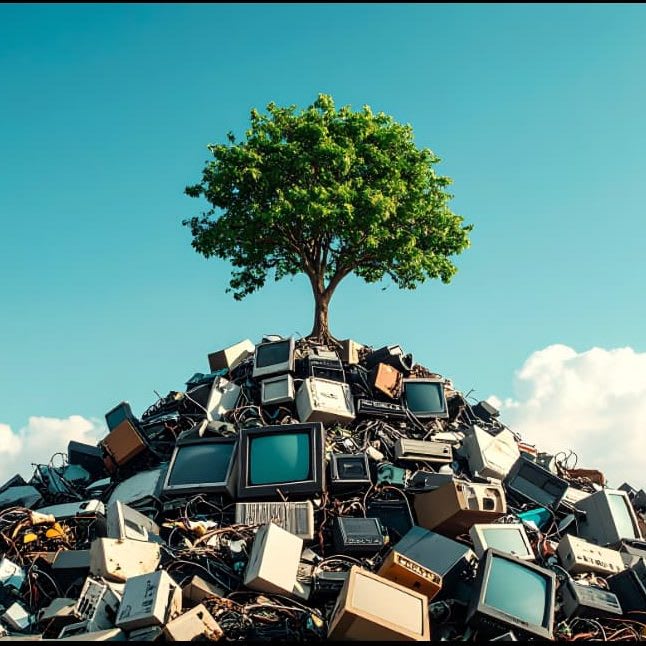
What Is E-Waste Management?
E-waste management is the systematic handling of end-of-life electronics — from the point they are discarded to the point their materials re-enter supply.
That chain runs: collection, transport under manifest, dismantling, segregation into material streams, refining, and controlled disposal of whatever genuinely cannot be recovered.
The word that matters in that sequence is systematic. Every stage is documented, which is what separates a managed process from a scrap transaction — and what makes it possible to prove afterwards where something went.
That is the standard a commercial e-waste programme has to meet.
E-Waste Management in India: Issues and Solutions
India's framework rests on Extended Producer Responsibility: producers are accountable for taking back what they put on the market, and bulk consumers are accountable for routing their retired electronics to authorized recyclers.
Alongside that sit the familiar 3Rs — reduce, reuse, recycle — and a push toward products designed to be repaired rather than replaced.
The framework is sound. The problem is that most e-waste never enters it.
The overwhelming majority is handled by the informal sector, where recovery happens through open burning and acid baths — methods that extract some value while destroying the rest and poisoning the people doing the work.
Challenges for E-Waste Management in India
Copying the model of a developed economy does not work here, because the constraints are different.
Formal recyclers compete against an informal sector with almost no overheads, which can therefore offer better prices for material it processes unsafely.
- Informal sector dominance — better prices, unsafe methods, no accountability
- Limited investment in formal collection and processing infrastructure
- A shortage of trained technicians for safe dismantling
- Weak enforcement, so compliance is effectively voluntary for many
- Low public awareness that electronics need separate disposal at all
- Unclear ownership of responsibility between producer, consumer and recycler
Strategies to Improve E-Waste Reduction and Recycling
Collection is the bottleneck, not processing. Formal capacity exists and is underused; what is missing is material reaching it.
That makes convenient, well-publicised collection — door-step pickup, drop-off points people actually know about — more valuable than additional plants.
Enforcement is the second lever. When bulk consumers are genuinely audited on their disposal records, demand for authorized recyclers rises immediately, because the certificate becomes something they need rather than something they are offered.
Companies can start by appointing an authorized recycler for corporate disposal.
The third is integration rather than elimination of informal collectors, who are extremely effective at gathering material and could feed formal processing instead of competing with it.
Where India's E-Waste Problem Actually Sits
The framework is not the weak point. EPR and the E-Waste Management Rules set out clear obligations for producers and bulk consumers alike.
The weak point is that most material never enters the framework, because the informal sector reaches it first and pays more for it.
That makes collection, enforcement and integrating informal collectors more valuable than building additional processing capacity.
For an organisation, the practical takeaway is simpler: use an authorized recycler and keep the certificate. That is what closes your file.