
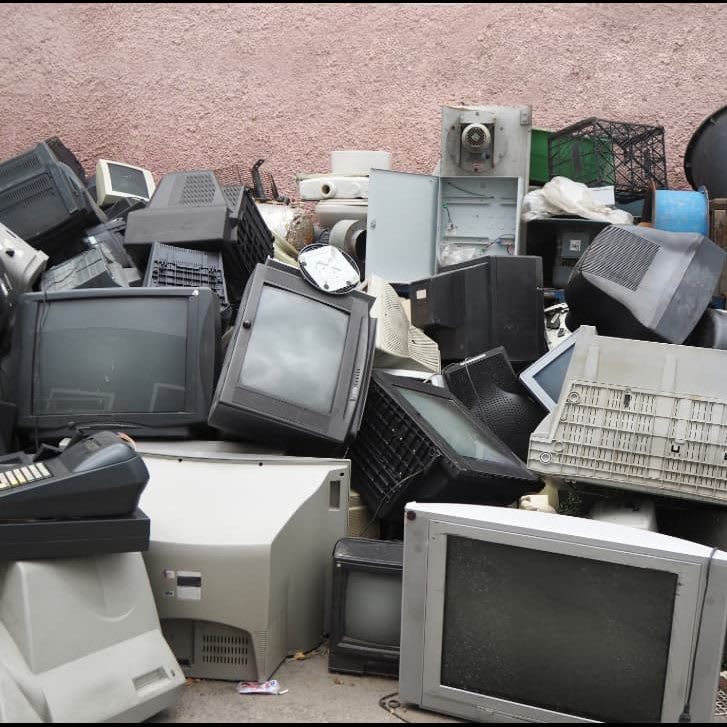
What Is E-Waste?
E-waste, or electronic waste, is any electrical or electronic device that has reached the end of its useful life — thrown away, traded in, or left in a cupboard because nobody knows what else to do with it.
The OECD defines it simply as any device powered by electricity that has stopped being useful to its owner.
The definition is broader than most people assume. A laptop is obvious. A kettle, a set of earphones, a smoke alarm and a laptop charger are all e-waste too.
If it runs on mains power or holds a battery, it belongs in this category and not in your household bin. See what we accept on our e-waste recycling page.
Kinds of Electronic Waste
Think about how many mobile phones you have owned. Around 40% of people replace a handset every two years, and roughly 38% replace it only when it stops working. Multiply that across a city and the scale becomes clear.
The European Union's WEEE framework — the classification most of the world borrows from — groups electronic waste into categories that are worth knowing, because they determine how an item has to be handled.
- IT equipment — desktops, laptops, servers, monitors, keyboards, printers, scanners
- Consumer electronics — televisions, audio equipment, cameras, set-top boxes
- Large appliances — refrigerators, washing machines, air conditioners
- Small appliances — kettles, irons, mixers, hair dryers, microwaves
- Lighting — CFL and fluorescent tubes, LED fittings
- Batteries — lead-acid, lithium-ion, UPS and inverter cells
- Telecom and network gear — routers, switches, modems, cabling
Can You Get in Trouble for Throwing Away Computers?
In India, yes — if you are an organisation. The E-Waste Management Rules place a legal obligation on bulk consumers to channel end-of-life electronics to an authorized recycler and to keep records of having done so.
A company that cannot produce that evidence at audit has a compliance problem, regardless of how tidily the equipment left the building.
For a household the legal exposure is smaller, but the practical risk is not.
Municipal waste collection is not equipped for electronics: a lithium cell crushed in a bin lorry is a genuine fire risk, and CRT glass and lead-acid units contaminate wherever they are landfilled.
Why Managing Electronic Waste Matters
Two reasons, pulling in opposite directions. The first is that e-waste is hazardous: lead in CRT glass and solder, mercury in screen backlights and lamps, cadmium in batteries and boards, and brominated flame retardants in casings.
Landfilled or burned in an open yard, all of these enter soil, groundwater and air.
The second is that e-waste is valuable. A tonne of circuit boards contains more gold than a tonne of ore from most mines. Copper, silver, palladium, aluminium and rare earths are all recoverable.
Every gram recovered is a gram that does not have to be mined, which is why formal recycling is an environmental gain twice over.
Human Health Consequences
The health cost falls hardest on informal recycling workers, who strip and burn boards without protection to recover metal. Lead exposure damages the nervous system and is particularly harmful to children. Mercury affects the brain and kidneys.
Cadmium accumulates in bone and kidney tissue. Burning plastic casings releases dioxins.
None of this is inevitable. It is what happens when e-waste reaches an unlicensed yard instead of a facility equipped to handle it.
Choosing an authorized recycler is not paperwork — it is the mechanism that decides which of those two routes your old computer takes. Our computer scrap collection ends at a licensed facility.
What E-Waste Means for You
E-waste is broader than most people picture: anything that runs on mains power or holds a battery, from a server to a set of earphones.
It is hazardous because of lead, mercury and cadmium, and valuable because of the gold, copper and silver alongside them. Both facts point to the same conclusion.
The decision that matters is not whether to recycle but who you hand it to. An authorized handler contains the hazard and recovers the value; an unlicensed yard does neither.
If you have electronics to clear in Chennai, book a free collection and you will get the paperwork proving where it went.