
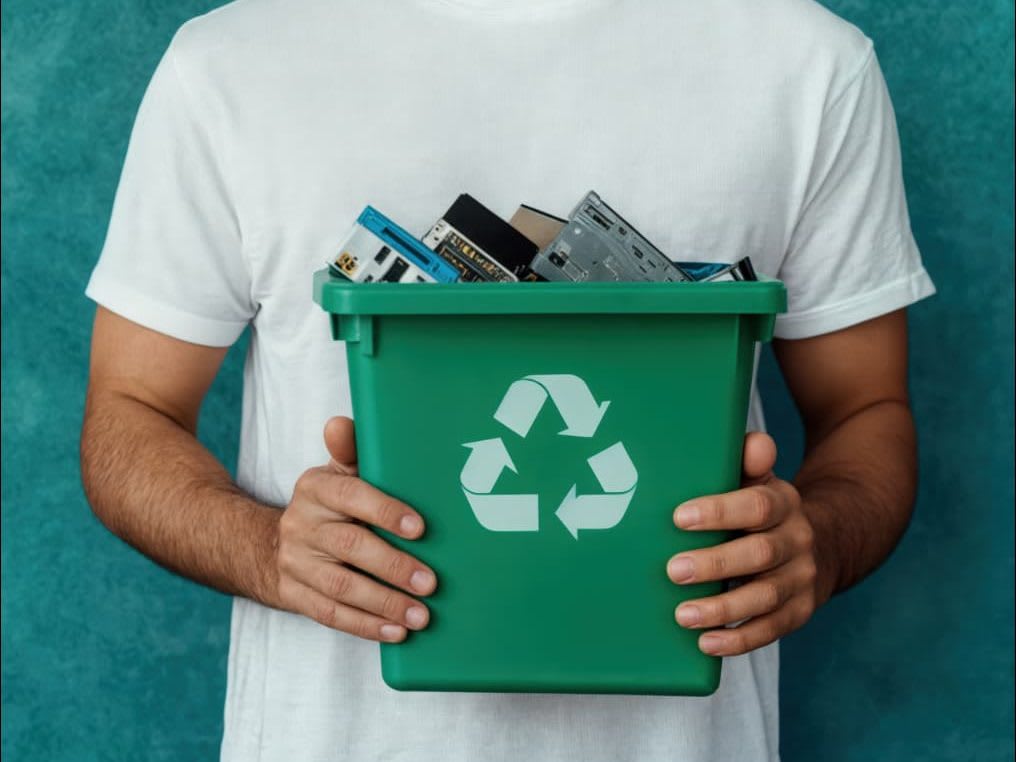
The Environmental and Health Impacts of Improper Disposal
Improperly discarded electronics release lead, mercury and cadmium into soil and water. Those materials do not degrade — they accumulate, moving into crops and groundwater and staying there.
The energy cost compounds it: manufacturing replacement devices from virgin material is far more carbon-intensive than recovering what already exists.
The flip side is that electronics are a concentrated store of reusable resource.
Gold, silver and copper are all recoverable at rates that make formal recycling worthwhile without subsidy — which is exactly why a licensed recycler can pay you for material an ordinary dealer would charge you to remove.
Legal Regulations and Compliance for E-Waste Disposal
India's E-Waste Management Rules make producers responsible for take-back under Extended Producer Responsibility, and place a parallel duty on bulk consumers — companies, institutions and government bodies —
to channel their retired electronics to authorized recyclers and to keep records available for inspection.
In practice, compliance comes down to a folder: a recycling certificate issued by an authorized recycler, a data destruction record for anything that held data, and an internal register tying both to your asset list.
If your vendor cannot supply the first two, the folder does not close.
Identifying Recyclable Electronics: What Can Be Recycled?
Almost everything, which surprises people.
Condition matters far less than composition — a dead laptop holds nearly the same recoverable material as a working one, because the value sits in the board, processor and metal chassis rather than in whether it powers on.
- Computers, laptops, servers and monitors — including non-booting units
- Printers, copiers and spent toner cartridges
- Televisions of every generation, including CRT sets
- Mobile phones, tablets and accessories
- Batteries — lead-acid, lithium-ion, UPS and inverter
- Large appliances — air conditioners, refrigerators, washing machines
- Cabling, routers, switches and networking hardware
Certified E-Waste Recycling Facilities: How to Find Them
Ask one question and insist on an answer: are you a government authorized handler, and will you show me the authorization? A licensed recycler provides it without hesitation. That applies to any e-waste scrap buyer you approach.
A dealer who deflects is almost always reselling your material to someone who holds a licence, and taking a margin out of your price to do it.
Two further checks are worth making. Does the recycler weigh material in front of you, or quote by guess? And do they issue a receipt at collection — not on arrival at their yard?
The gap between those two moments is where accountability normally disappears.
Preparing Your Electronics for Recycling
Back up anything you want to keep, then sign out of accounts on the device — not just the device itself but the services tied to it. Remove SIM cards and memory cards from phones.
Deleting files or running a format is not disposal: both are trivially reversible with freely available tools.
For anything that held customer, financial or medical data, do not rely on your own wipe. Have the drive destroyed under a documented process and keep the certificate. See certified data destruction.
Remove batteries where they come out easily, and declare any swollen or damaged cell when you book the collection so it is packed correctly.
Alternatives to Disposal: Donation, Repair and Reuse
Not everything at the end of its life for you is at the end of its life. A three-year-old laptop fleet usually has real market value, and a working machine given to a school does more good than its scrap weight ever will.
A good recycler will tell you when an item is worth more as an asset than as material — and quote accordingly rather than buying it as metal.
Disposing of Electronics Well: The Three Things That Matter
Check the vendor's authorization before you hand anything over — that single question separates a licensed recycler from a dealer reselling to one.
Deal with your data before the device leaves you. Deleting and formatting are both reversible; only destruction under certificate is evidence.
Ask whether an item is worth more as a working asset than as scrap. A good recycler will tell you when it is, rather than buying it as metal.
Get those three right and everything else — collection, weighing, paperwork — follows.