
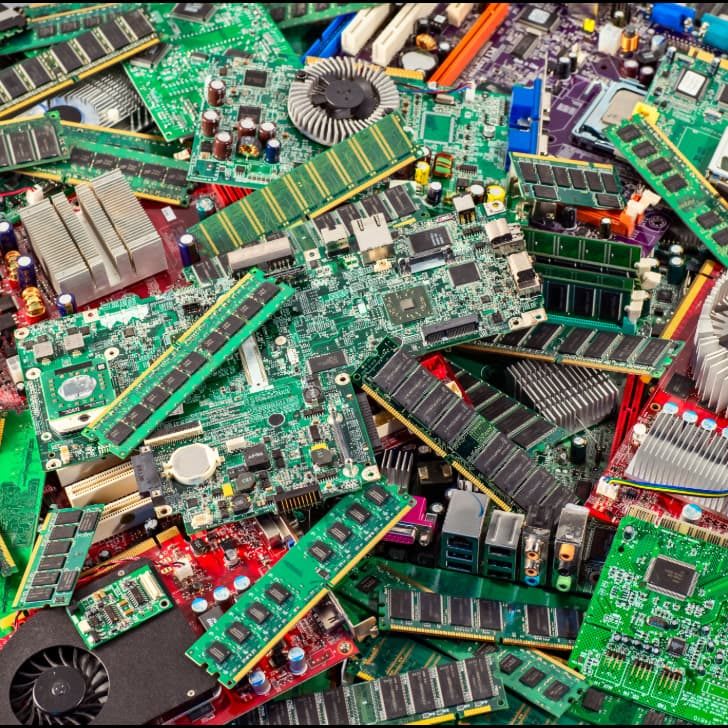
The Current State of E-Waste Recycling
Millions of tonnes are generated annually and only a modest share is formally recycled.
The reasons are consistent across most markets: collection is fragmented, informal processing outcompetes formal facilities on price, and awareness that electronics need separate handling remains low.
The constraint is collection rather than capacity. Formal processing facilities are frequently underused while material flows past them into informal channels.
Key Trends Shaping the Future
Several shifts are visible now rather than hypothetical.
- Circular economy design — products built to be repaired and disassembled, not just replaced
- Better recovery technology — automated sorting, improved separation, cleaner hydrometallurgy
- Data security integrated into recycling rather than treated as a separate service
- Stronger EPR enforcement, making producers genuinely accountable for take-back
- Green IT procurement, with disposal terms written into purchase contracts
- Urban mining treated as a serious materials supply, not a side effect
- Cross-border cooperation on the movement and tracking of e-waste
Urban Mining Becomes a Supply Strategy
As accessible ore grades decline and demand for copper, lithium and rare earths rises, recovering metal from discarded electronics stops being an environmental gesture and becomes a supply decision.
Circuit boards already carry higher gold concentrations than most working ore bodies, and the material is above ground and already collected.
Data Security Moves Into the Recycling Process
Historically, wiping and recycling were separate transactions with separate vendors and a gap between them. That gap is where accountability disappeared.
The direction of travel is toward a single documented chain — drives logged at collection, destroyed by an agreed method and reconciled in one report.
That is already how a serious programme works. See our data destruction service for how per-serial logging and certification fit into collection.
What This Means for Businesses
Three practical consequences. Disposal terms will increasingly be written into procurement contracts rather than handled at end of life. Compliance evidence will be audited more often and more closely.
And the residual value of retired hardware will matter more as recovered material becomes genuinely valuable.
The organisations that handle this well are the ones treating disposal as a scheduled programme with a known vendor and consistent documentation, rather than a phone call made in a hurry when a store room fills up.
Where E-Waste Recycling Is Heading
Collection remains the bottleneck, not processing capacity. Formal facilities are underused while material flows past them.
Urban mining is becoming a supply decision rather than an environmental gesture, as ore grades fall and demand for copper and lithium rises.
Data destruction is merging into the recycling process itself, closing the gap where accountability used to be lost between two vendors.
For businesses that means disposal terms in procurement contracts, closer audit of compliance evidence, and residual value that is worth arguing about.