
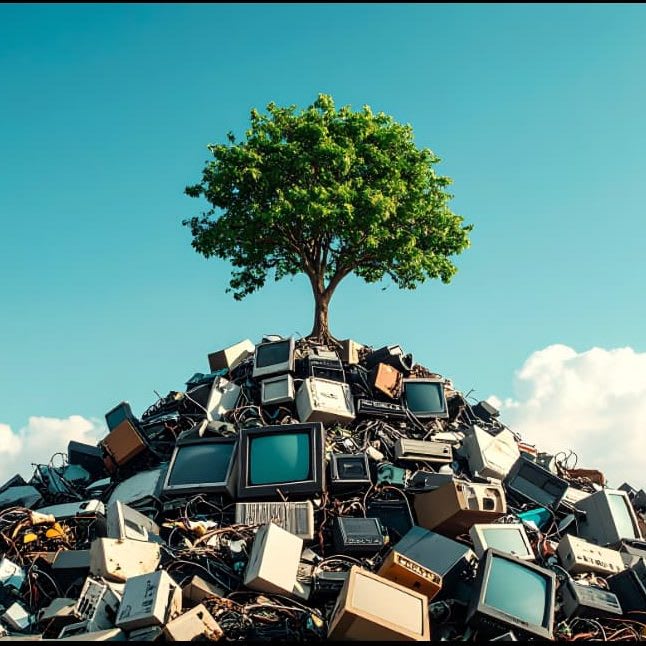
The Growing Challenge of Corporate E-Waste
Effective corporate e-waste management is a necessary discipline for modern businesses. It is the systematic handling of retired electronics to ensure data security, regulatory compliance, and environmental responsibility.
The scale of the issue is immense. Globally, 62 million tonnes of e-waste were generated in 2022, as per the Global E-waste Monitor 2024. This equates to 7.8 kg per person and is growing relentlessly.
This growth is driven by shorter product lifecycles and rapid technological upgrades. The global e-waste volume is projected to reach 82 million tonnes by 2030, showing a trend that far outpaces recycling efforts.
The data reveals a stark disparity. Since 2010, e-waste generation has grown nearly five times faster than the documented formal recycling rate. This widening gap represents a significant global challenge.
In India, the challenge is also acute. The Central Pollution Control Board (CPCB) reported to the Lok Sabha in March 2026 that 13.97 lakh metric tonnes were generated in FY2024-25, with recycling efforts struggling to keep pace.
This isn't just waste; it's a massive economic loss. The Global E-waste Monitor 2024 estimates that US$62 billion in recoverable resources like gold, copper, and palladium went unaccounted for in 2022 from discarded electronics.
- Global e-waste generation is on track to exceed 82 million tonnes by 2030.
- Only 22.3% of e-waste was formally collected and recycled in 2022, with the rate projected to fall to 20% by 2030.
- India generates over 1.3 million metric tonnes of e-waste annually, posing a significant management burden.
- Improper disposal leads to the loss of billions in valuable materials that could be returned to the supply chain.
- Corporate sources, from servers and laptops to networking gear, are a major contributor to the e-waste stream.
- A structured management plan is essential for any organisation generating electronic waste.
Regulatory Framework in India: The E-Waste (Management) Rules, 2022
The handling of electronic waste in India is governed by the E-Waste (Management) Rules, 2022. Enforced from 1 April 2023, these rules create a stricter compliance framework for all stakeholders.
The rules apply to 106 categories of electrical and electronic equipment (EEE). This wide scope covers nearly every device with a circuit board, from large data centre servers to office lighting and mobile phones.
A central concept is the "bulk consumer." This term applies to any organisation, including companies, government offices, and institutions, that uses large quantities of electronics. These entities have specific legal duties.
Bulk consumers must ensure their end-of-life electronics are channelled only to government-authorized recyclers. Disposing of e-waste with municipal solid waste or selling it to the informal scrap market is strictly prohibited.
The rules also codify Extended Producer Responsibility (EPR). This obligates producers, importers, and brand owners to fund and manage the collection and recycling of their products at the end of their life.
Failure to comply can result in severe penalties under the Environment (Protection) Act, 1986. This includes substantial fines and potential legal action against the organisation's leadership for non-compliance.
- The E-Waste (Management) Rules, 2022, provide the legal framework for e-waste handling in India.
- Bulk consumers are legally obligated to hand over e-waste only to government-authorized recyclers.
- The rules cover 106 categories of equipment, making them applicable to nearly all businesses.
- Partnering with certified Chennai e-waste recyclers is a mandatory compliance step for businesses in the region.
- EPR requires producers to finance and manage systems for collecting their end-of-life products.
- Documentation proving compliant disposal must be maintained for audits by the CPCB or State Pollution Control Boards (SPCBs).
Risks of Improper E-Waste Disposal for Businesses
Failing to manage e-waste correctly exposes a business to significant operational, financial, and legal risks. The most severe and immediate threat often comes from unsecured data on retired assets.
Discarded hard drives, servers, phones, and even printers store sensitive data. This can include intellectual property, customer lists, and financial records. Simple deletion is insufficient as data can be recovered with basic tools.
A data breach from a carelessly discarded asset can lead to catastrophic reputational damage, customer loss, and legal penalties. A formal data destruction service is the only way to mitigate this risk completely.
Environmental liability is another major concern. The 'cradle-to-grave' principle holds the waste generator responsible. If your branded equipment is found in an illegal dump leaching toxins, your company can be held liable for cleanup.
There are also direct financial costs. Old servers continue to draw power, occupy expensive rack space, and require cooling. Their unpatched firmware creates security holes, making timely disposal a cost-saving measure.
Finally, many assets retain value. A structured IT asset disposition programme can identify equipment suitable for resale or recover commodity value from scrap, turning a cost centre into a revenue source.
- Data breaches from improperly discarded storage media are a primary security risk.
- Hazardous materials in e-waste, like lead and mercury, can lead to environmental liability.
- Reputational damage from being linked to pollution or data leaks can impact brand value for years.
- Non-compliance with the E-Waste Rules can result in significant fines and legal action.
- Organisations lose the residual financial value of assets when they are not properly processed.
- Keeping obsolete hardware running incurs unnecessary power, cooling, and space costs.
Components of a Corporate E-Waste Management Programme
An effective e-waste programme is a planned, documented process. It starts with creating a clear policy that defines how and when assets are retired, and who is responsible for overseeing the process.
The first practical step is inventory. Maintain a detailed list of all assets designated for retirement, including asset tags, serial numbers, and device types. This list is the foundation for a secure chain of custody.
Before handover, IT staff should perform preliminary steps. This includes removing any SIM cards or external memory cards and, if policy dictates, performing an initial software-based data wipe on devices.
Segregation at the source is vital. Different e-waste types require different handling. Batteries, which pose a fire risk, must be stored separately from general IT equipment. Lamps containing mercury require special care.
Designate a secure, dry, and access-controlled area for storing e-waste before collection. This prevents theft of data-bearing devices or valuable components and protects equipment from damage that could release hazardous materials.
The final component is partnership.
Choosing a single, authorized recycler simplifies logistics, ensures consistent documentation, and provides a single point of accountability for the entire disposal process for all corporates.
- Develop a formal asset retirement policy defining disposal triggers and responsibilities.
- Create and maintain a serialized inventory of all assets intended for disposal.
- Segregate hazardous items like batteries and lamps from other electronic waste.
- Designate a secure, controlled storage area for accumulating e-waste.
- Ensure IT teams remove removable media like SIMs and memory cards before handover.
- Consolidate disposal activities with a single, authorized recycling partner for efficiency and accountability.
Secure Data Destruction: A Non-Negotiable Step
For any organisation, data security must extend to the end of an asset's life. Data destruction is a specific security function that must be verifiably completed before an asset is recycled for its material value.
Software-based wiping, which overwrites data, can be effective but has critical limitations. It is slow for large volumes and cannot sanitize failed or physically damaged drives. It is also unreliable for Solid-State Drives (SSDs).
The architecture of SSDs, with features like wear-levelling, means software cannot guarantee that all data blocks have been overwritten. This makes physical destruction the only certain method for SSDs.
Physical destruction provides absolute certainty. The two primary methods are degaussing, which uses a powerful magnetic field to erase magnetic media like HDDs and tapes, and shredding, which physically destroys the media itself.
Shredding is the most secure and universally applicable method.
It reduces hard drives, SSDs, backup tapes, and phones into small, irregular fragments, making data reconstruction physically impossible. This is the standard for all data-bearing devices.
The entire process must be auditable. Your vendor must provide a data destruction certificate that lists the serial numbers of all destroyed devices. This document is your legal proof of due diligence and secure data sanitization.
- Software wiping is not sufficient for damaged drives or modern Solid-State Drives (SSDs).
- Physical destruction via shredding offers the highest, most verifiable level of data security.
- Degaussing is effective for magnetic media but does not work on SSDs or optical media.
- On-site destruction can be arranged, allowing you to witness the process for maximum assurance.
- A certificate of data destruction with serial numbers is essential for compliance audit trails.
- The certificate proves you took necessary steps to prevent a data breach from retired assets.
The Recycling and Resource Recovery Process
Once data is destroyed, the recycling process begins. At an authorized facility, e-waste is carefully dismantled to separate valuable commodities from hazardous materials in an environmentally sound manner.
The process starts with manual dismantling. Trained technicians de-manufacture each item into its core components: circuit boards, power supplies, plastic casings, metal frames, wiring, and glass. This requires skill to avoid releasing toxins.
These streams are then segregated. For instance, circuit boards are collected for precious metal recovery. Wires are stripped for their copper. Metals are sorted into ferrous (steel) and non-ferrous (aluminium, copper) categories.
Hazardous components are carefully isolated. This includes leaded glass from old CRT monitors, mercury from fluorescent lamps, and cadmium from batteries. These are sent to specialized downstream facilities equipped to handle them safely.
The value of the scrap is determined by commodity markets, like the London Metal Exchange (LME) for copper and aluminium. The price you receive is based on these rates, minus the recycler's processing costs, and depends on material purity.
Recovered commodities are then baled, packed, and sold as raw materials to smelters and manufacturers. This re-entry into the supply chain conserves natural resources, saves energy, and reduces the need for virgin mining.
- Recycling begins with manual dismantling to separate primary components and hazardous parts.
- Materials are meticulously sorted by type, such as different plastics, metals, and circuit boards.
- Hazardous materials are isolated and managed separately according to strict environmental protocols.
- Recovered commodities are processed and sold back to manufacturers, supporting a circular economy.
- The value of scrap material is tied to global commodity prices and the cost of processing.
- This process turns potential liabilities into valuable raw materials for new products.
Documentation and Compliance for Bulk Consumers
For a bulk consumer, the process is not complete when the e-waste is collected. Maintaining proper documentation is a legal requirement and your primary defence in a compliance audit.
The chain of custody begins with your internal asset list. This is cross-referenced with a collection challan at pickup. This unbroken trail is crucial for tracking every asset from your premises to its final disposition.
The most important document is the recycling certificate. This is issued by the authorized recycler and details the type and quantity of e-waste processed on your behalf, proving you have met your legal obligation.
A valid certificate should contain the recycler's CPCB authorization number, your company's details, the date of processing, and the total weight and/or quantity of e-waste handled. It is your proof of compliant disposal.
For data-bearing assets, you must also obtain and retain a separate data destruction certificate. This should provide a serialized inventory of all media that have been physically destroyed, confirming data security.
These certificates are not just paperwork; they are your legal proof of compliance. They must be maintained and produced during an audit by the CPCB or your SPCB. Retain them for at least five years as a best practice.
- Maintain a complete chain-of-custody record, from asset list to final certificate.
- A recycling certificate is the primary legal document proving compliant e-waste disposal.
- A data destruction certificate provides an auditable record of secure data sanitization.
- These documents are mandatory for demonstrating compliance during regulatory audits.
- Verify that certificates include the recycler's authorization number and details of the waste processed.
- A comprehensive report from your recycler should reconcile all assets and provide all necessary certificates.
Choosing an Authorized E-Waste Recycling Partner
Selecting a recycling partner is a critical decision impacting your risk and compliance. The first and most important criterion is their legal authorization to operate. Do not work with an unauthorized vendor.
You must verify their status. Ask for a copy of their CPCB or SPCB authorization and check it against the official list on the CPCB portal. Ensure the authorization is current and covers the facility processing your material.
Next, evaluate their security protocols. Ask about secure transport, 24/7 CCTV at their facility, access control, and employee background checks. This is vital for protecting your data-sensitive assets until they are destroyed.
Assess their technical capabilities and transparency. A good partner can handle all your e-waste streams and is willing to let you audit their facility. Ask for sample reports and certificates to review their documentation quality.
Inquire about their downstream network. A responsible recycler vets and audits their own partners who handle specialized materials (like mercury or precious metals). They should be able to demonstrate this downstream due diligence.
Finally, check references, especially from organisations in your sector. A recycler with experience serving banks or healthcare providers will better understand the heightened security and compliance needs of those industries.
- Verify that the recycler is officially authorized by the CPCB or SPCB on the government portal.
- Scrutinize their physical and data security measures to protect assets during transit and processing.
- Ask critical questions about their downstream vendors, insurance coverage, and reporting processes.
- Demand transparent processes, including the right to audit their facility and review sample documentation.
- Choose a partner with the technical capacity to process all types of e-waste you generate.
- Check client references to confirm their reliability, especially within your specific industry.
Conclusion: E-Waste as a Strategic Responsibility
Corporate e-waste management is much more than waste disposal. It is an integrated function of risk management, data security, regulatory compliance, and corporate social responsibility.
A proactive and structured approach protects your organisation’s sensitive data, preserves its brand reputation, and ensures full adherence to India's environmental laws. It is a key part of sustainable business operations.
Partnering with a government-authorized, professional recycler like Sree E-Waste Recycling provides the expertise, security, and documentation needed to manage this responsibility effectively, ensuring your assets are handled safely and sustainably.