
What is E-Waste and Why Is It a Growing Concern?
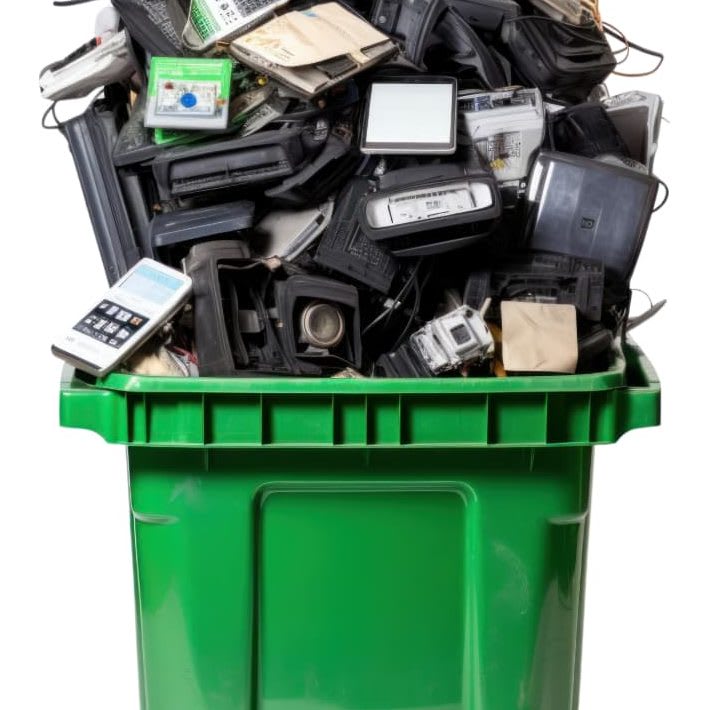
The question of how to recycle electronics begins with understanding the scale of the problem. Electronic waste, or e-waste, includes any discarded product with a battery or a plug.
This broad definition covers a vast range of items. Under India's regulations, it spans 106 categories, from IT equipment like servers and laptops to consumer goods like televisions, refrigerators, and mobile phones.
Globally, 62 million tonnes of e-waste were generated in 2022, averaging 7.8 kg per person, according to the Global E-waste Monitor 2024. This figure is on track to reach a staggering 82 million tonnes by 2030.
The core issue is the widening gap between generation and formal recycling. Only 22.3% of the 2022 total was documented as formally collected and recycled. As generation accelerates, this rate is projected to fall to just 20% by 2030.
According to UNITAR/ITU, e-waste generation has been growing almost five times faster than documented recycling since 2010. This imbalance has a significant economic cost.
The Global E-waste Monitor 2024 notes that an estimated US$62 billion worth of recoverable natural resources, like gold and copper, were lost or unaccounted for in discarded electronics in a single year.
- Global e-waste generation reached 62 million tonnes in 2022 and is projected to hit 82 million by 2030.
- The formal recycling rate was only 22.3% and is expected to decline further as generation outpaces capacity.
- E-waste growth is outpacing formal recycling by nearly a factor of five, a trend holding since 2010.
- The value of unrecovered resources in e-waste represents an annual economic loss of over US$62 billion.
The Risks of Unregulated E-Waste Disposal
Improper disposal methods, such as mixing e-waste with household trash or giving it to informal scrap dealers, create substantial environmental, health, and security risks.
Informal recycling often involves crude methods like open-air burning of circuit boards and cables to melt away plastic and extract small amounts of copper and gold.
This low-temperature, incomplete combustion does not destroy hazardous materials. Instead, it releases a toxic cocktail of chemicals into the atmosphere.
The plastics and flame retardants in electronics produce dioxins and furans when burned, while the lead in solder and mercury in older screens and switches become airborne particulates.
These hazardous materials can contaminate soil and groundwater when dumped in landfills or informal yards. The heavy metals persist in the environment for decades, entering the food chain.
A critical and often overlooked risk is data security. Devices handed to the informal sector are rarely wiped properly, leaving personal and corporate data accessible to anyone who recovers the hardware.
- Health Hazards: Inhalation of toxic fumes from burning electronics is linked to severe respiratory ailments and neurological damage.
- Environmental Contamination: Heavy metals like lead and mercury can leach from dumpsites and poison local water supplies for generations.
- Data Breaches: Discarded hard drives and mobile phones are a primary source for identity theft, financial fraud, and corporate espionage.
- Resource Loss: Crude extraction methods are inefficient, failing to recover the vast majority of valuable materials present in e-waste.
India's Regulatory Framework: The E-Waste (Management) Rules, 2022
India has a comprehensive legal framework to govern electronic waste. The E-Waste (Management) Rules, 2022, came into force on 1 April 2023, replacing earlier regulations with stricter norms.
A central pillar of the rules is Extended Producer Responsibility (EPR). This principle obligates the producers, manufacturers, and importers of electronic goods to manage the collection and recycling of their products at end-of-life.
The rules also define responsibilities for "bulk consumers," such as corporations, government departments, and other large organisations. These entities must ensure their e-waste is channelled only to authorized recyclers.
Bulk consumers are also expected to keep records of what was discarded and where it went. The precise record-keeping duty has shifted between rule revisions, so confirm the current position for your category.
According to figures presented to the Lok Sabha in March 2026, the Central Pollution Control Board (CPCB) reported that India generated 14,14,645 metric tonnes of e-waste in FY2025-26.
The reported recycling total for that period was 9,79,080 metric tonnes, a figure that was still accumulating at the time of the report. This compares to 13.97 lakh MT generated and 11.59 lakh MT recycled in FY2024-25.
In FY2023-24, the country generated 12.54 lakh MT of e-waste and processed 7.78 lakh MT through formal channels, showing a consistent effort to scale up recycling capacity.
- The rules apply to 106 categories of electrical and electronic equipment (EEE), covering nearly all devices with a plug or battery.
- Extended Producer Responsibility (EPR) mandates that producers finance and manage the collection and recycling of their products.
- Bulk consumers are legally required to dispose of their e-waste through authorized recyclers and maintain disposal records.
- A centralized online portal is used to track e-waste quantities and ensure compliance from producers and recyclers.
- Non-compliance with these rules can result in financial penalties and legal action under the Environment (Protection) Act, 1986.
How to Recycle Electronics: A Step-by-Step Guide for Individuals
For individuals and households, recycling electronics responsibly involves a few distinct steps. Following this process ensures your data is safe and the device materials are handled correctly.
Before anything else, back up any photos, documents, or files you wish to keep. Transfer them to a new device, an external hard drive, or a secure cloud storage service.
The next step is to physically remove any SIM cards or external memory cards (e.g., microSD). These small items are often forgotten but contain a high concentration of personal data.
Then, you must erase your data. A simple "factory reset" is not a secure wipe. It only removes the pointers to your files, leaving the actual data on the drive, where it can be recovered with basic software.
For true data security on laptops or PCs, use a dedicated disk-wiping software utility. These tools overwrite the entire drive with random data, making recovery practically impossible.
For anything genuinely sensitive, use a certified data destruction service instead, and keep the certificate.
Once data is handled, find a legitimate disposal channel. This means a government-authorized e-waste recycler, or an official collection point designated by a producer. Never leave electronics on the kerbside.
Loose batteries go separately to battery scrap buyers, because a swollen lithium cell is a fire risk in a mixed load.
- Step 1: Consolidate all unused electronics, including phones, laptops, chargers, and cables.
- Step 2: Back up all important data you want to save from your old devices.
- Step 3: Physically remove all SIM cards and memory cards.
- Step 4: Securely erase your information. Use the factory reset option on phones, but for laptops with sensitive data, use disk-wiping software or a professional data destruction service.
- Step 5: If your device has a user-removable battery, take it out. Swollen lithium-ion batteries are a fire hazard and are handled separately by recyclers like professional battery scrap buyers.
- Step 6: Drop the device off at an authorized collection centre. Sree E-Waste has collection centres in Perungudi (OMR) and Velachery.
E-Waste Management for Businesses and Bulk Consumers
For corporations and other bulk consumers, e-waste management is a matter of legal compliance, data governance and corporate responsibility.
The process is formal and needs documentation, which is why most corporate clients run it as a standing programme rather than an ad-hoc clearance.
E-waste is also rarely the only stream on a site. A workshop or production floor generates metal offcuts, swarf and machining scrap, and those follow a different route to a different buyer.
It is worth handling that side deliberately rather than letting it pile up in a corner. RG Tech Engineering Works has a practical guide to how engineering workshops dispose of metal waste.
Organisations must have a clear policy for asset retirement. This involves tracking equipment from procurement to disposal in an IT asset register and defining clear end-of-life criteria.
A formal IT asset disposition (ITAD) programme is the industry standard for managing this. A certified ITAD partner handles logistics, secure data sanitization, and compliant recycling in an auditable manner.
Data destruction is non-negotiable. Recyclers must provide services meeting global standards like NIST 800-88, offering everything from multi-pass software erasure to on-site physical shredding of hard drives.
Different sectors have unique compliance needs. For instance, banks and financial institutions work under regulator and auditor expectations about how customer data is sanitized before a retired asset leaves the premises.
Similarly, educational institutions and government offices must manage large, periodic volumes of diverse device types while ensuring accountability for public data and assets.
- Maintain a complete chain of custody with documented asset transfer forms for every step, from your office to the recycling facility.
- Demand and retain the documents that actually prove disposal: a recycling certificate for the consignment and a data destruction certificate listing each drive by serial number.
- Keep asset lists and certificates on file well past the disposal date. Auditors ask about historical consignments, not only the most recent one.
- For high-security assets, use on-site data destruction services where hard drives are shredded at your premises before transport.
- Thoroughly vet your recycling partner. Verify their CPCB authorization and ask for certifications like ISO 27001 (Information Security) and ISO 14001 (Environmental Management).
What Happens to a Device After Collection?
Once an electronic device is collected, it begins a multi-stage journey from a whole product back to raw materials. This process is methodical and designed to maximize resource recovery.
The first stage is manual dismantling. At an authorized facility, trained technicians carefully break down each device into its primary components. A laptop, for example, is separated into its casing, screen, keyboard, battery, and circuit boards.
Next comes segregation. The dismantled parts are sorted into distinct material streams.
Plastics are grouped by type, metals separated into ferrous and non-ferrous, and circuit boards sorted by grade.
Data-bearing components like hard drives and SSDs are immediately secured. They are either digitally sanitized using specialized software that overwrites the data, or physically shredded into tiny fragments to ensure information is irrecoverable.
Finally, the segregated materials are sent for recovery. Circuit boards go to advanced smelters to extract gold, silver, and copper. Commodity-grade plastics, glass, and metals are processed to be sold back into manufacturing supply chains.
- Stage 1: Secure Collection. Assets are securely transported from the client's location to the authorized recycling facility with a clear chain of custody.
- Stage 2: Manual Dismantling. Technicians take apart devices to separate core components like batteries, screens, and circuit boards, which require different processing.
- Stage 3: Material Segregation. Components are sorted by material type (e.g., ABS plastic, aluminium, steel, glass, high-grade PCBs).
- Stage 4: Data Destruction. Hard drives and other storage media are securely wiped or physically destroyed according to client requirements.
- Stage 5: Refining and Recovery. Sorted materials are sent to specialized downstream partners for smelting and purification, re-entering the circular economy as raw materials.
How to Verify a Government-Authorized E-Waste Recycler
The effectiveness of the recycling system depends entirely on using an authorized recycler. Unauthorized handlers bypass environmental safeguards and data security protocols, negating the purpose of recycling.
The most reliable verification method is to check the official list of registered recyclers on the Central Pollution Control Board (CPCB) website. This list is the definitive source of truth.
An authorized recycler operates from a registered physical facility equipped for dismantling and segregation. Be cautious of operators who only have a collection storefront or work out of a vehicle without a proper processing unit.
Ask for proof of authorization directly. A legitimate recycler will readily provide their CPCB registration number and other permits. They should also provide a clear service agreement outlining their processes.
As a government-authorized recycler operating under the trademark Redit Eco Recycling, Sree E-Waste Recycling provides fully compliant services for all types of e-waste recyclers in Chennai.
We ensure all materials are processed according to the E-Waste (Management) Rules, 2022, providing a transparent and auditable trail for every client, from individuals to large corporations.
- Question 1: "Are you authorized by the CPCB? Can you provide your registration number?"
- Question 2: "What is your process for data destruction, and can you provide a certificate?"
- Question 3: "What certificates do you issue, in what format, and how soon after collection?"
- Question 4: "Can we audit your facility to observe your processes?"
- Question 5: "Who are your downstream partners for hazardous materials like batteries and leaded glass?"
The Material Value Within Electronic Waste
It is a misconception that e-waste is worthless. Discarded electronics are a rich source of secondary raw materials, which is why formal recycling is often called "urban mining."
Printed circuit boards (PCBs) contain valuable precious metals, including gold, silver, palladium, and platinum, in addition to base metals like copper and aluminium in high concentrations.
Formal recycling uses advanced, capital-intensive metallurgical processes to extract these materials safely and with high efficiency. This reduces the immense environmental and social costs associated with mining new ore.
This inherent value is why a regulated market exists for electronic scrap, and why computer scrap buyers pay by weight and grade rather than by the item. The price paid for scrap material is not arbitrary; it is a calculated figure.
Pricing follows the weight and grade of the material, tracking global commodity rates, less the recycler's processing cost.
High-grade server boards fetch considerably more per kg than low-grade mixed consumer electronics.
- Precious Metals: Gold, silver, platinum, and palladium are recovered from connectors, pins, and circuit board surfaces.
- Base Metals: Copper is abundant in wiring, transformers, and PCBs. Aluminum is common in heat sinks and device frames.
- Plastics: Casings from laptops, printers, and monitors can be shredded, sorted, and recycled into new plastic pellets for manufacturing.
- Glass: Screens from monitors and TVs contain glass that can be recovered, though older CRT glass requires special handling due to its lead content.
Responsible Recycling is a Deliberate Process
Knowing how to recycle electronics is less about finding the nearest bin and more about following a structured, deliberate process. It is an act of environmental stewardship and data security.
For individuals, this means securely wiping data and finding a legitimate drop-off point. For businesses, it means implementing an auditable compliance program through a documented chain of custody.
The key to both is partnering with a government-authorized recycler. This ensures that retired assets are handled in a way that protects sensitive information, complies with Indian law, and recovers valuable resources for the circular economy.