
Why Gold Is Used in Electronics
Gold is expensive, and manufacturers use it anyway — which tells you it is solving a problem nothing cheaper solves. Four properties explain it.
- Conductivity — excellent, behind only silver and copper, with very low resistivity
- Corrosion resistance — gold does not oxidise, so contacts stay reliable for decades
- Malleability — can be applied in extremely thin plating without cracking
- Reliability — critical where a failed contact means a failed device
Electronics with Gold Content
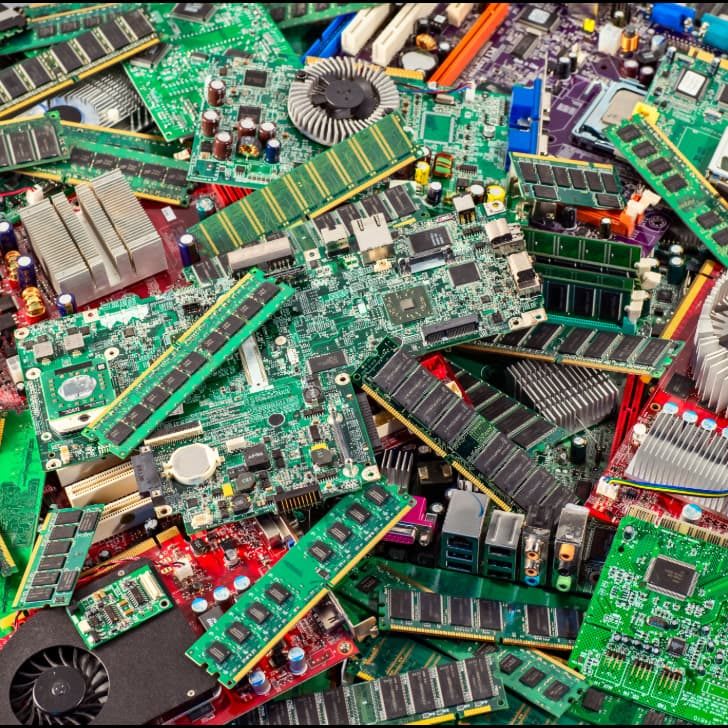
Gold is concentrated where signal integrity matters most — connectors, contacts and processor packaging. Quantities per device are tiny, which is why individual scavenging is not worthwhile, but they add up at scale.
- CPUs — gold in the pins and internal bonding wires
- Memory modules (RAM) — plated edge connectors
- Printed circuit boards — plated traces, pads and vias
- Connectors and contacts — edge connectors, pin headers, SIM and card slots
- High-end audio equipment — plated interconnects and terminals
How Gold Is Recovered from Electronic Waste
Recovery is a sequence, and each stage exists for a reason. Skipping stages is precisely what informal recycling does, which is why it recovers less while causing more harm. It is the same chain our recycling process follows.
- Collection and sorting — devices separated by type so boards can be isolated
- Mechanical processing — dismantling, shredding and granulating to liberate material
- Chemical leaching — gold dissolved into solution under controlled conditions
- Precipitation and purification — gold recovered from solution and impurities removed
- Smelting and refining — melted and refined to high purity
- Bullion production — cast into bars for return to the metals market
Why the Method Matters
The chemistry that recovers gold is genuinely hazardous. Done inside a licensed facility, leaching happens in contained systems with the spent solution treated before discharge.
Done in an informal yard, the same chemistry happens in open buckets and the residue goes into the ground.
The difference is not the gold recovered — informal methods actually recover less, because they cannot process the fractions that need real equipment. The difference is everything else that happens alongside it.
Urban Mining: The Bigger Picture
Recovering metal from discarded devices rather than from ore is often called urban mining, and the arithmetic is favourable.
Concentrations in circuit boards exceed those in most working ore bodies, the material is already above ground and collected, and no new extraction site is disturbed to reach it.
For the person or company disposing of equipment, this is why a licensed recycler can pay for material rather than charge to remove it. The value is genuinely there — the question is only whether it is recovered properly.
For corporate volumes see IT asset disposition.
Gold in Electronics: Real, but Not a Side Project
Gold is used in electronics because nothing cheaper matches its conductivity and corrosion resistance in a contact that must last decades.
It concentrates in CPUs, RAM edge connectors, board plating and card slots — tiny amounts per device, meaningful amounts per tonne.
Recovery is a six-stage process, and each stage exists for a reason. Informal methods skip most of them, recovering less while releasing far more.
Do not attempt it yourself. The chemistry is genuinely dangerous and the yield from any household quantity is negligible.