
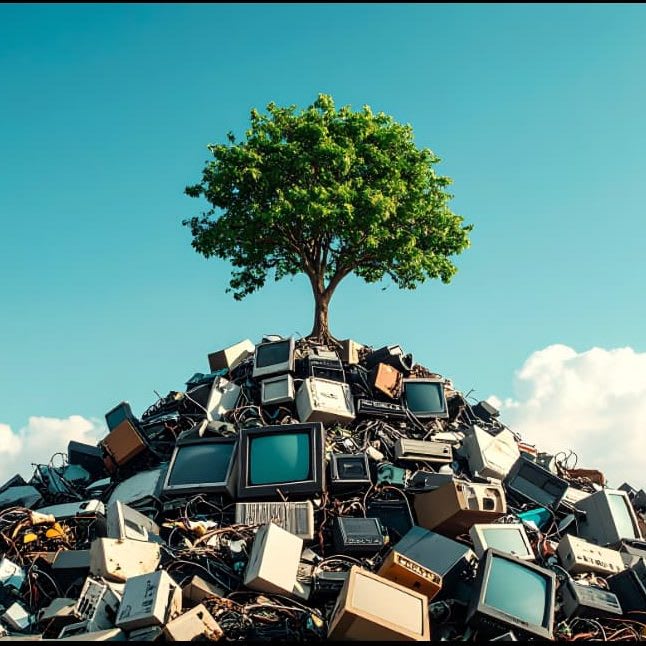
Environmental Benefits
The immediate benefit is pollution avoided. Electronics that reach a licensed facility have their hazardous fractions separated and contained rather than leaching from a landfill or entering the air from an open fire.
Nothing about the device changes — only where it goes.
Conservation of Natural Resources
Electronics are unusually concentrated stores of metal. A tonne of circuit boards yields more gold than a tonne of ore from most working mines, alongside silver, copper, palladium and aluminium.
That is why selling e-waste for recovery displaces real damage.
Recovering those metals displaces mining demand directly.
That matters because mining is where most of the environmental cost of electronics actually sits — deforestation, tailings, water contamination and very high energy use, all before a single component is manufactured.
Energy Savings
Producing metal from recovered material takes a fraction of the energy of producing it from ore.
Recycled aluminium needs roughly 95% less energy than primary smelting; recovered copper and gold show large savings on the same principle, because the energy-intensive extraction step has already happened once.
Those savings translate into avoided emissions, which is why formal e-waste recycling reduces carbon output rather than simply relocating waste.
Reduction of Landfill Waste
Electronics are bulky and dense. Diverting them from landfill frees capacity for waste that genuinely has nowhere else to go, and removes the long-term contamination liability that buried electronics create for decades afterwards.
Economic Advantages and Job Creation
Formal recycling supports skilled work — collection, dismantling, sorting, refining, logistics and compliance — that informal burning does not. Recovered material also enters domestic manufacturing supply, reducing dependence on imported raw metal.
For the organisation disposing of the equipment there is a direct return too: material with recoverable value is paid for, and assets with residual market worth are often worth considerably more sold as working equipment than as scrap.
See computer scrap buyers for how that is valued.
Safe Disposal of Hazardous Materials
The residue that genuinely cannot be recovered still has to go somewhere. In a licensed process it goes to controlled disposal under manifest, documented from the point of collection.
That documentation is the part that makes the whole chain verifiable — and it is exactly what an informal route cannot provide.
What Recycling Electronics Actually Achieves
Hazardous materials are contained rather than released — the immediate and largest gain.
Metals are recovered instead of mined, displacing the deforestation, tailings and water contamination that sit upstream of every new device.
Energy use falls sharply, because the extraction step has already happened once. Recycled aluminium alone needs roughly 95% less energy than primary smelting.
The case does not rest on sentiment. It rests on four measurable outcomes, and all four follow from a single decision about where the material goes.