
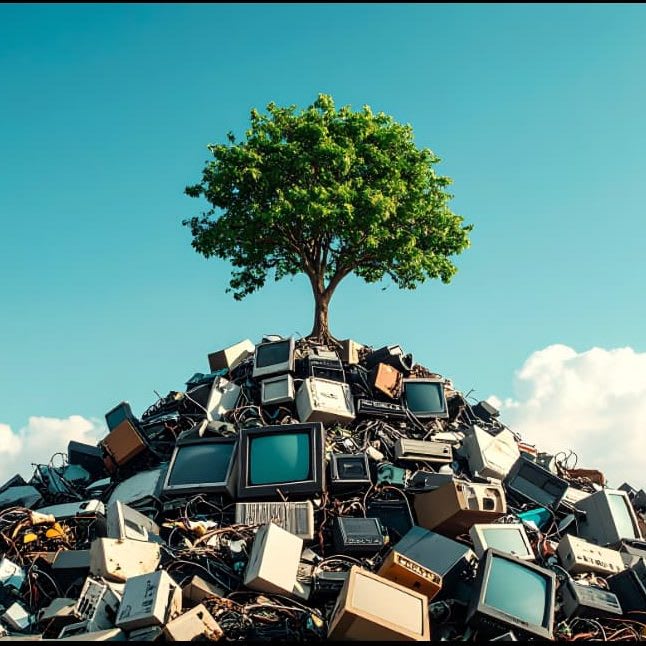
What Is Solar Waste?
Solar waste is discarded or damaged photovoltaic panels together with the equipment around them — inverters, batteries, mounting hardware and cabling.
Panels typically last 25 to 30 years before output degrades enough to justify replacement, but breakage, storm damage and manufacturing defects retire some far earlier.
Why Solar Waste Management Matters Now
India's solar capacity has expanded enormously over a short period, which means the retirement wave will also arrive over a short period rather than being spread out.
Panels installed in the early build-out are approaching end of life while new capacity continues to be added.
A panel is not inert. It contains silicon, silver, aluminium, copper and glass worth recovering, and depending on type, lead or cadmium compounds that should not be landfilled. The batteries and inverters alongside it are e-waste in their own right.
Solar Panel Recycling in India: Current Scenario
Dedicated panel recycling capacity remains limited.
Most end-of-life panels currently go to general scrap channels, where the aluminium frame and junction box are recovered and the laminate — the part holding most of the recoverable material and all of the hazard — is discarded.
Regulation is beginning to catch up, with solar waste being brought into the e-waste rules framework, but infrastructure is still ahead of the panels arriving rather than behind them.
That window is an opportunity to build capacity before the volume peaks.
Challenges in Solar Waste Management
Recycling a panel is genuinely harder than recycling a laptop.
- Panels are laminated — layers are bonded specifically to survive decades of weather
- Recoverable value per panel is low relative to the processing effort required
- Installations are geographically dispersed, making collection expensive
- Dedicated processing capacity is limited and concentrated
- Ownership at end of life is often unclear between installer, owner and financier
What Happens to the Rest of a Solar Installation
The panels are only part of it. Inverters, charge controllers, cabling and — most significantly — the battery bank are all conventional e-waste, and the batteries are regulated hazardous waste requiring manifest transport and licensed processing.
We handle that side today. See battery scrap buyers in Chennai for solar battery banks and e-waste scrap buyers for inverters, controllers and cabling.
India's Solar Waste Wave Is Close
Panels last 25 to 30 years, and India's first large build-out is approaching that mark while new capacity keeps being added.
Dedicated recycling capacity is limited. Most retired panels currently go to general scrap, where the frame is recovered and the laminate discarded.
The laminate is where most of the recoverable material and all of the hazard sits, which makes that the part worth solving.
The rest of an installation — inverters, controllers, cabling and the battery bank — is conventional e-waste today, and we handle it now.