
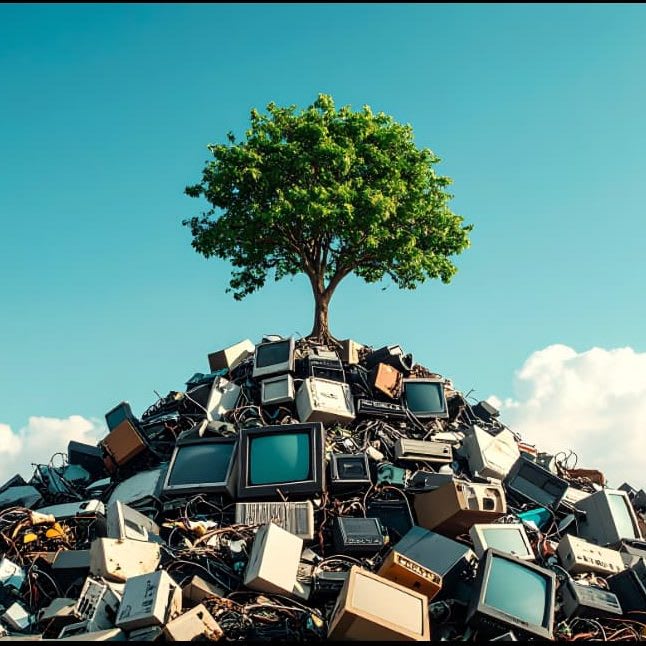
The Global E-Waste Challenge
Knowing where to recycle old electronics is a critical question for a world producing vast quantities of it. The volume of discarded devices is growing substantially faster than our capacity to manage it through formal systems.
In 2022 alone, the world generated 62 million tonnes of e-waste, as reported by the Global E-waste Monitor 2024. This equates to an average of 7.8 kg per person on the planet, a figure set to rise.
Of this staggering amount, only 22.3% was documented as formally collected and recycled. The vast majority of retired electronics are not processed through recognized channels, leading to significant material and environmental loss.
Projections indicate the problem is worsening. E-waste generation is on track to reach 82 million tonnes by 2030. The same report projects the documented recycling rate will fall to just 20% by then.
This decline is partly due to the increasing complexity of products, which have more integrated components and embedded batteries. These designs make repair and recycling more difficult and costly, slowing down processing.
Since 2010, the generation of e-waste has outpaced the growth in formal recycling by a factor of nearly five. This widening gap represents a major challenge for sustainable resource management globally.
- An estimated US$62 billion worth of recoverable natural resources, like gold, copper, and palladium, went unaccounted for in 2022 due to improper disposal.
- Informal recycling methods, such as burning cables to recover copper or using acid baths for circuit boards, release dioxins, lead, and mercury into the environment.
- These hazardous substances contaminate soil and water, posing severe health risks to workers and nearby communities, including respiratory illnesses and neurological damage.
- Rapid technology cycles and the decreasing cost of new devices are primary drivers of e-waste generation, encouraging more frequent replacement.
The Indian E-Waste Context
India faces its own significant e-waste management challenges, driven by a large population and a rapidly growing economy. The country has established a robust regulatory framework to address this issue head-on.
According to figures presented to the Lok Sabha in March 2026 by the Central Pollution Control Board (CPCB), India has seen a steady increase in both e-waste generation and documented recycling.
In the 2024-25 fiscal year, the country generated 13.97 lakh metric tonnes of e-waste and documented the recycling of 11.59 lakh metric tonnes. This shows a substantial and growing processing capacity.
For the prior fiscal year, 2023-24, generation was 12.54 lakh MT with 7.78 lakh MT recycled. The trend indicates a positive trajectory in scaling up formal recycling infrastructure and compliance.
Data for FY 2025-26 showed generation at 14,14,645 metric tonnes with 9,79,080 tonnes recycled. These figures were still accumulating at the time of reporting, suggesting continued growth in formalisation.
Despite progress, a significant gap between generation and recycling persists. This gap is largely filled by the informal sector, where materials are recovered using unsafe and inefficient methods.
- The informal sector, including 'kabadiwalas', has historically managed much of India's waste but often lacks the technology for safe e-waste processing.
- The government's goal is not to eliminate these jobs but to integrate informal workers into the formal system through training and safer employment.
- The CPCB's role is central to monitoring, regulating, and authorizing the entire e-waste management ecosystem, from producers to recyclers.
- State Pollution Control Boards (SPCBs) work with the CPCB to enforce regulations locally, conducting inspections and granting licenses to compliant facilities.
Understanding the E-Waste (Management) Rules, 2022
The primary legislation governing e-waste in India is the E-Waste (Management) Rules, 2022. These rules came into force on 1 April 2023, superseding previous regulations with a more stringent, comprehensive approach.
The rules expand the scope of covered items to 106 categories of electrical and electronic equipment (EEE). This broad list ensures nearly all consumer, commercial, and industrial electronics are included.
A central pillar of the rules is Extended Producer Responsibility (EPR). This principle makes producers, importers, and brand owners financially and logistically responsible for the end-of-life management of their products.
Under EPR, producers must meet specific, ambitious recycling targets. They fulfill this by collaborating with authorized recyclers and demonstrating compliance through a centralized online portal managed by the CPCB.
For businesses, the rules are also clear. Any 'bulk consumer' must ensure its e-waste is channelled only to authorized recyclers or dismantlers. They are required to maintain records to prove this compliance.
A bulk consumer is any entity, public or private, that uses a large number of electronics. This includes all corporate offices, factories, government offices, and educational institutions.
- The rules aim to transition e-waste handling from the informal sector to the formal sector to ensure environmental safety and improve material recovery rates.
- Non-compliance with EPR targets or bulk consumer duties can result in significant financial penalties under the 'polluter pays' principle, along with potential legal action.
- To prove compliance, a bulk consumer must keep records such as transport manifests, asset handover lists, and the final recycling certificate issued by the recycler.
- This documentation creates an auditable trail, demonstrating that retired assets were managed responsibly from the point of disposal to final recycling.
What Defines a Government-Authorized Recycler?
The term 'authorized' is not arbitrary; it signifies that a recycler meets strict criteria set by the CPCB and the respective SPCB. This is the primary distinction between formal and informal operators.
An authorized facility holds the necessary permits, including Consent to Establish (CTE) and Consent to Operate (CTO). These are granted only after demonstrating environmentally sound management practices.
This includes having the correct machinery for safe dismantling, pollution control devices like dust collectors and effluent treatment plants, and trained personnel who follow strict safety protocols.
When vetting a recycler, you should ask to see their valid CPCB or SPCB authorization. Also, ask about their process for data destruction and if they permit client audits of their facility.
Working with a recognized partner is the only way for a business to receive the legally valid documentation required under the 2022 Rules. Informal scrap dealers cannot provide this assurance.
As government-authorized e-waste recyclers in Chennai, we are equipped to provide the necessary compliance certificates for all waste we process, ensuring your legal obligations are met.
- Authorization requires adherence to specific guidelines for the secure storage, transportation, and processing of e-waste.
- Authorized recyclers are subject to periodic inspections and audits by pollution control authorities to ensure ongoing compliance.
- These facilities must maintain detailed records of the quantity and type of e-waste received, processed, and sent to downstream partners for final material extraction.
- Choosing an authorized recycler protects your organisation from the legal, financial, and reputational risks associated with improper disposal.
The Process of Formal E-Waste Recycling
Once e-waste arrives at an authorized facility, it undergoes a systematic process to maximize resource recovery and minimize environmental impact. The process begins with weighing, logging, and manual sorting.
Different categories of equipment are segregated. For instance, CRT monitors, which contain leaded glass, are handled separately from laptops or servers to prevent cross-contamination and ensure specialized processing.
The next stage is manual dismantling. Skilled technicians use specialized tools to break down each unit into its core components: circuit boards, plastic casings, metal frames, wiring, power supplies, and batteries.
This segregation is critical. Components like printed circuit boards (PCBs) are rich in precious metals, while plastics must be sorted by polymer type for effective recycling. Any remaining data storage media is physically destroyed at this stage.
Batteries in particular require careful handling.
We operate as licensed battery scrap buyers, ensuring that lithium-ion, lead-acid, and other battery types are routed to dedicated facilities that can safely manage their chemistries.
After dismantling, separated materials are shredded, baled, or crushed to reduce volume and prepare them for transport. These homogenous streams of plastic, aluminium, steel, and copper are then sent to specialist smelters for final extraction.
- The goal of formal recycling is material recovery, transforming waste back into valuable raw materials for manufacturing, thus closing the loop in a circular economy.
- Hazardous substances like mercury from flat-panel displays, cadmium from old batteries, and brominated flame retardants are carefully isolated and neutralized.
- The efficiency of this process directly impacts the circular economy by reducing the demand for virgin raw materials, which in turn saves energy and reduces CO2 emissions.
- All these activities are performed by trained workers wearing appropriate personal protective equipment (PPE) in a well-ventilated environment.
The Economics of E-Waste: Costs, Value, and Pricing
A common question is whether there is monetary value in old electronics. The answer is complex and depends on volume, material composition, and prevailing commodity market prices.
Recycling e-waste correctly is not free. It requires significant investment in facilities, specialized equipment, trained labour, and environmental controls. These operational costs must be covered.
The value in e-waste comes from the commodities recovered. Base metals like copper, steel, and aluminium make up most of the weight. Precious metals like gold, silver, and palladium in circuit boards provide higher value but in tiny amounts.
How is scrap pricing set? The value of bulk e-waste scrap buyers offer is directly tied to global commodity prices on exchanges like the London Metal Exchange (LME).
This price is then adjusted for the recycler's processing costs.
For businesses with large volumes, the recovered material value can offset some or all of the service costs for logistics, data destruction, and processing. This can result in a low, zero, or even positive net cost.
For individual items, the logistics and processing costs almost always exceed the recovered material value. The real 'payment' is the assurance of secure and environmentally responsible disposal.
- The purity of a material stream significantly impacts its value; clean, well-sorted materials command higher prices from smelters and refiners.
- Due to volatile commodity markets, quotes for e-waste scrap are typically valid for a very short period, sometimes only for a single day.
- The EPR framework is designed to internalize the cost of recycling into the product's price, ensuring the system is financially sustainable.
- The cost of proper disposal should be weighed against the far greater potential costs of data breach fines, non-compliance penalties, and brand damage.
Ensuring Data Security in Asset Disposition
For any organisation, the data on retired assets is a greater liability than the hardware itself. Old hard drives, servers, and mobile phones can contain sensitive corporate, employee, or customer information.
Simply deleting files or formatting a drive is insufficient. Data can often be recovered with commercially available software, creating a significant risk of a data breach long after an asset has left your premises.
This is why secure data destruction is a non-negotiable part of the IT asset disposition process. It must be performed before the device is physically recycled, and it must be verifiable.
Software-based wiping is one method. It overwrites the drive with random data according to standards like NIST SP 800-88. This is suitable for drives that may be reused. For drives destined for recycling, physical destruction is absolute.
Physical destruction involves shredding, crushing, or degaussing the storage media. This is the most secure method for highly sensitive data, as it renders the media completely inoperable and unreadable.
Upon completion, a formal data destruction certificate is issued. This legal document is your proof of due diligence. It should list the serial numbers of destroyed media, the method used, date, and location.
- A formal data destruction policy, as part of a broader information security programme, is essential for any organisation handling sensitive information.
- Our data destruction service offers both certified wiping and physical shredding to meet your specific security requirements.
- The certificate of destruction is a critical piece of compliance paperwork, protecting your organisation in case of an audit or legal inquiry.
- Failing to properly sanitize data from retired assets can lead to severe regulatory fines under privacy laws, alongside irreparable reputational damage.
E-Waste Solutions for Corporates and Bulk Consumers
Corporates, banks, factories, and educational institutions are defined as 'bulk consumers' under Indian law. This status brings a direct legal responsibility to manage e-waste through authorized channels.
We provide tailored solutions for corporates that include scheduled pickups, on-site collection bins, and detailed asset tracking. This simplifies the logistics of managing an IT asset retirement programme.
The process typically begins with an inventory of the assets slated for disposal. This creates a clear chain of custody from your premises to our recycling facility, which is essential for audit and compliance purposes.
For industries like banking, data security is paramount. We work with banks to ensure that asset disposition aligns with stringent internal security policies and regulatory mandates like those from the RBI.
After secure data destruction, value can be recovered from retired enterprise hardware.
As experienced computer scrap buyers, we assess the material value of servers and networking gear to provide a fair return or cost offset.
Ultimately, the service provides a complete compliance package. You receive all necessary documentation, including asset transfer forms, data destruction certificates, and the final recycling certificate.
- A structured disposition programme reduces the internal administrative burden of managing obsolete electronics and ensures consistency.
- Regularly clearing out old equipment frees up valuable office or data centre space, reduces power consumption, and eliminates security risks from unsupported hardware.
- Partnering with a single vendor for pickup, data destruction, and recycling streamlines the entire end-of-life process, improving efficiency and accountability.
- Our services help organisations meet their corporate social responsibility (CSR) and environmental, social, and governance (ESG) targets.
Responsible Recycling for Households and Individuals
While regulations focus on bulk consumers, responsible disposal by individuals is vital for protecting the environment. Household e-waste, in aggregate, contributes significantly to the overall stream.
Common household items like old mobile phones, laptops, chargers, cables, and kitchen appliances all fall under the e-waste category. These should never be mixed with regular municipal solid waste.
Before handing over any device, it is crucial to protect your personal data. For phones and laptops, sign out of all accounts (Google, iCloud, etc.), back up your data, and then perform a full factory reset.
Physically remove any SIM cards and memory cards from the device. These are small and easily missed, but they can contain a great deal of personal information. Keep or destroy them separately.
Informal scrap collectors may offer a small payment, but they often use crude, unsafe methods for dismantling. This releases harmful toxins like lead and mercury into the local environment, posing a risk to everyone.
The most direct way to ensure proper recycling is to take your old electronics to a designated collection centre. This guarantees they enter a formal, environmentally sound recycling chain, like our centres in Chennai.
- Check with electronics retailers, as many have take-back programmes for their own products, mandated under EPR.
- Accumulate smaller items like cables, chargers, and earphones in a box and drop them off periodically at a collection point.
- Encourage your residential community or apartment complex to organize a dedicated e-waste collection drive with an authorized recycler.
- By choosing formal channels, you support a system that recovers resources safely and prevents pollution.
Choosing the Right Channel for Disposal
The question of where to recycle old electronics has a clear, definitive answer: through a government-authorized facility. This is the only path that guarantees legal compliance, data security, and environmental responsibility.
For businesses, the choice is a matter of law and risk management. Engaging with a certified partner provides an auditable trail, mitigates data breach liability, and fulfills duties under the E-Waste (Management) Rules, 2022.
For individuals, the choice is one of stewardship. Formal recycling channels convert potential pollutants into valuable resources, contributing to a circular economy and protecting community health from the toxins released by informal methods.
Whether managing a corporate IT refresh or disposing of a single phone, the principles are the same. Proper e-waste management is a critical function in a modern, technology-dependent society. It is an investment in a cleaner, more secure future.